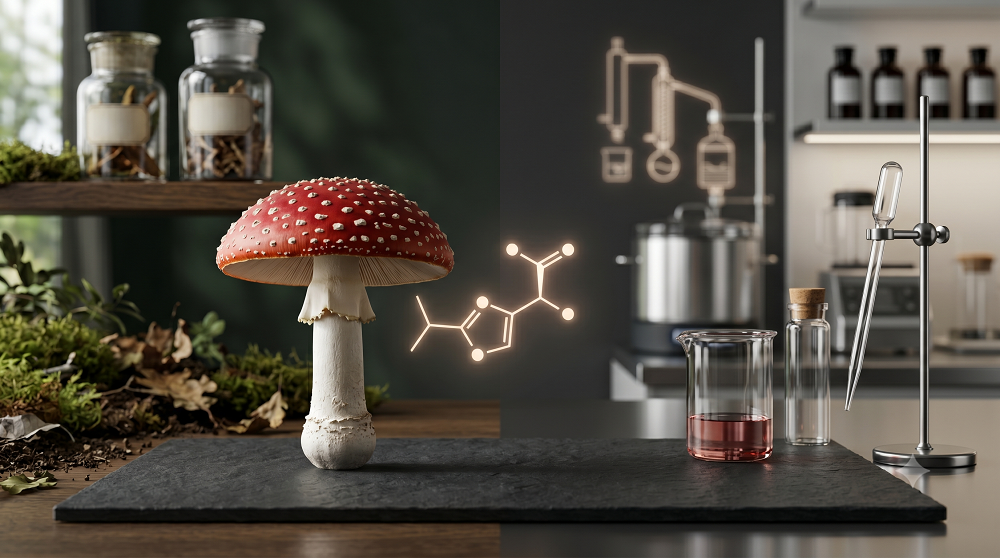
Ibotenic acid is a naturally occurring neurotoxic amino acid found primarily in mushrooms of the Amanita genus, such as Amanita muscaria (fly agaric) and Amanita pantherina (panther cap). It is a potent chemical compound that is highly toxic to brain tissue.
Ibotenic acid is the compound almost no one talks about, even though it shapes nearly every Amanita muscaria experience. It is the molecule behind the mushroom’s harsh edge, and understanding it explains why preparation matters so much.
Most people jump straight to muscimol and skip its rowdy precursor entirely. That is a mistake, because ibotenic acid is the part that can make raw or poorly processed Amanita unpleasant and occasionally risky.
At Mushroom Magical, we built our products around taming this exact compound, and we are glad to walk you through how that works. If you want a straight answer about any product before you buy, contact us today!
So What Exactly Is Ibotenic Acid?
Ibotenic acid is a naturally occurring excitatory compound found in Amanita muscaria and its close relative Amanita pantherina, and it acts as the precursor that converts into muscimol. It is one of two active molecules that define how these mushrooms affect the body.
The Short Version
Think of ibotenic acid as the raw, unfinished version of what most people are actually after. It is an excitatory compound the mushroom produces in its tissue, and it sits most heavily in the cap rather than the stem. On its own, it tends to cause more discomfort than calm, which is the opposite of what fans of Amanita usually describe.
Here is the key trait: ibotenic acid is a precursor, not a final product. Under the right conditions it transforms into muscimol, the gentler compound responsible for the relaxed, dreamy quality people seek.
Left unconverted, though, it stays active in its harsher form. That single fact is why two products made from the very same mushroom can feel worlds apart depending on how they were handled.
A Glutamate Look-Alike
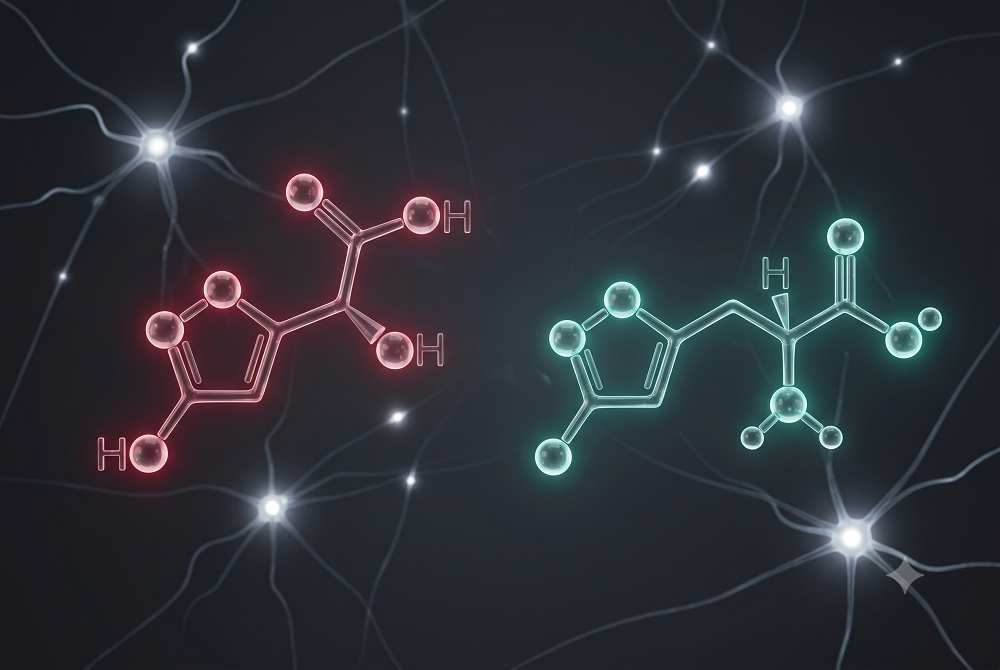
The reason ibotenic acid is so active comes down to its shape. It closely resembles glutamate, the main excitatory neurotransmitter your brain uses to fire signals and stay alert.
Because of that resemblance, ibotenic acid binds to glutamate receptors, especially the NMDA receptors that drive neural excitation. In plain terms, it revs neurons up rather than settling them down.
That excitatory push is what separates it from muscimol on a chemical level, and it is the root of both its rough side effects and its scientific reputation. Your body reads ibotenic acid as a “go” signal, and too strong a go signal is rarely a comfortable thing.
Wait, Isn’t It the Same as Muscimol? (Not Even Close)
People lump the two together because they come from the same mushroom and travel as a pair. Pharmacologically, they sit at opposite ends of the spectrum.
Ibotenic Acid vs Muscimol: Two Compounds, Opposite Jobs
Ibotenic acid and muscimol are chemical relatives with opposite effects: ibotenic acid stimulates neurons while muscimol sedates them.
Ibotenic acid is excitatory: it activates NMDA glutamate receptors and pushes neurons toward firing. Muscimol is inhibitory: it activates GABA-A receptors, the brain’s primary calming system, and quiets activity down.
So while they share a parent mushroom and a chemical lineage, their effects pull in opposite directions. This is not a subtle distinction either, since one compound winds the nervous system up and the other winds it down. When you understand that split, the rest of the Amanita story suddenly makes sense.
Why the Difference Changes Everything
The practical fallout of that opposition shows up in how a product actually feels. The balance between these two compounds is the experience.
A preparation loaded with unconverted ibotenic acid tends to bring nausea, jitteriness, sweating, and a generally rough ride. A preparation where most of it has become muscimol leans toward relaxation, heaviness, and a sleepy, reflective calm.
Same mushroom, same starting material, radically different outcome. That is why “how much Amanita” is the wrong question, and “how was it processed” is the right one. The ratio is the whole game, and ibotenic acid is the variable nobody should ignore.
Okay, So Is Ibotenic Acid Actually Dangerous?
Short answer: ibotenic acid is the compound responsible for most of the nausea and discomfort linked to raw Amanita, but properly converted and lab-tested products reduce most of that risk. Here is what it actually does, without the panic.
The Reason Raw Amanita Makes People Sick
If you have read warnings about Amanita muscaria causing nausea and vomiting, ibotenic acid is usually the culprit. Raw and home-dried material tends to carry a lot of it.
The compound concentrates in the cap and stays potent when the mushroom is eaten fresh or simply air-dried without enough processing. That is why traditional cultures developed careful drying and preparation methods over centuries, long before anyone could name the chemistry.
They learned through trial and error that unprepared mushrooms were the rough ones. The gastrointestinal distress, the sweating, the uneasy edge most beginners fear: those all trace back to ibotenic acid that never finished its transformation into muscimol.
Why Labs Use Ibotenic Acid to Lesion Brain Tissue
 This is where ibotenic acid earns real respect. Neuroscientists use it as a research tool to deliberately destroy specific neurons in lab animals.
Injected directly into a precise brain region, ibotenic acid overexcites neurons until they die, a process called excitotoxicity, where excessive NMDA activation floods cells with calcium. Researchers favor it because it makes clean, targeted lesions and is more predictable than older alternatives.
That sounds alarming, and it deserves honesty. But context matters: those studies use direct injection into brain tissue at controlled doses, nothing like a tested oral product where most of the compound has already been converted. Still, it tells you exactly why removing or transforming ibotenic acid is the entire point of good preparation.
How Worried Should You Actually Be?
Real talk: the lab context sounds frightening, but it is not the situation a careful consumer is in. The risk from a properly handled product looks nothing like raw caps or a research injection.
The trouble from ibotenic acid scales with two things: how much of it survives to reach you and how much you take. Convert most of it to muscimol, measure what is left, start with a small amount, and you have neutralized the main variables that cause problems.
That is the entire logic behind decarboxylation and lab testing, and it is why we treat both as requirements rather than nice extras. Caution is smart here, but fear is not the point, and the gap between the two comes down almost entirely to preparation and dosing.
Respect the compound, buy from people who test it, go low to start, and ibotenic acid becomes a detail rather than a threat.
How Much of It Is Even in the Mushroom?
Concentration is not uniform across an Amanita muscaria mushroom, and it is not constant from one mushroom to the next. Both facts matter the moment you start thinking about dosing or processing.
It Lives in the Cap
Ibotenic acid is not spread evenly through the mushroom. It concentrates most in the cap, particularly the colorful skin and the flesh just beneath it, while the stem carries noticeably less.
Muscimol follows a roughly similar pattern but skews toward the flesh under the cap. For anyone working with raw material, that uneven distribution means a pile of caps and a pile of stems are not interchangeable.
It also explains why traditional preparers paid such close attention to which parts they used and how they dried them. The compound profile of a single mushroom is really a patchwork, not a tidy uniform dose, and that unevenness is one more reason raw use is so hard to predict.
Wild Mushrooms Are a Gamble
Even if you knew exactly which part to use, the numbers would still move on you. Ibotenic acid levels swing with the season, the soil, the rainfall, and the age of the mushroom when it was picked.
Two caps from the same patch, gathered weeks apart, can carry very different amounts. That variability is the core problem with foraged or home-prepared Amanita, because you simply cannot know what you have without testing it.
A casual eyeball estimate of potency tends to fail, sometimes uncomfortably so. Standardized products exist to remove this guessing game, swapping natural variation for a measured, repeatable amount.
Here’s the Twist: It Becomes Muscimol
This is the part that flips the whole story. Ibotenic acid is not a dead end. It is a doorway.
Through a chemical reaction called decarboxylation, ibotenic acid loses a small piece of its structure and converts into muscimol, the calmer compound people are actually chasing. This is the chemistry we explain in detail in how decarboxylation works, and it is the difference between a rough mushroom and a refined product.
A few factors drive that conversion:
- Heat: controlled warming in roughly the 175 to 200°F range, the window commonly cited for decarboxylation, pushes the reaction forward; go much hotter and the muscimol you just created starts to degrade.
- Drying and time: air-drying alone converts only part of the ibotenic acid, with reported conversion often around a third, so resting and additional processing finish what nature starts.
- Your own liver: even ibotenic acid that reaches your system gets partly converted, because it acts as a prodrug your body turns into muscimol.
The takeaway is that the harsh compound and the gentle one are really two stages of the same molecule. Good preparation simply moves more of it across the finish line, which is why careful processing alone can turn a rough experience into a smooth one. Everything that follows in a quality product flows from how completely that conversion was done.
What This Means When You’re Buying Amanita Products (It’s Important)
All of this lands on one practical point. The amount of leftover ibotenic acid in a product is the single biggest factor in how it will feel.
 Vague labeling like “contains Amanita extract” tells you nothing about that balance, which is why we report what is actually in each batch. A real certificate of analysis lists both muscimol and ibotenic acid content, so you can see how thoroughly the conversion was done rather than guess.
You can check ours through our third-party lab reports, and that transparency is the whole reason standardized products exist. When the chemistry is measured instead of assumed, you get a consistent experience instead of a coin flip, and that is exactly what we aim for with our lab-tested Amanita gummies.
Properly processed, properly tested, properly labeled: that is how ibotenic acid stops being a liability.
None of this asks you to become a chemist or a forager. It simply means leaning on products that already did the measuring, so the only decision left to you is how much to take and when.
Is Ibotenic Acid Even Legal?
Legality is one of the first things people ask, and the answer is more layered than a simple yes or no. The short version is that it depends on where you live and how a product is used.
Amanita muscaria and its compounds, including ibotenic acid and muscimol, are not listed under the federal Controlled Substances Act, which sets them apart from psilocybin. That means they are not federally scheduled across the United States.
The notable exception is Louisiana, which under state law (Act 159) restricts these mushrooms for consumption and permits them only for ornamental purposes. Separately, the Food and Drug Administration has alerted the industry that Amanita muscaria and its constituents are not authorized as ingredients in conventional food.
None of this is legal advice, and rules can shift, so checking your own state and local law before you buy is always the smart move.
How to Skip the Guesswork Entirely
The honest takeaway is simple: ibotenic acid is not evil, but it is the part you want converted and measured before it ever reaches you. Proper decarboxylation and third-party testing are what turn a rough raw mushroom into something predictable.
At Mushroom Magical, we handle that work so you do not have to gamble on a home batch or a mystery label. If you are unsure which option fits you, reach us at (442) 359-4314 and we’ll point you to a batch with the lab work already done.
Disclaimer: This article is for informational and educational purposes only and is not medical advice. Amanita muscaria products are not intended to diagnose, treat, cure, or prevent any disease and have not been evaluated by the Food and Drug Administration. Consult a qualified healthcare provider before use, especially if you take medications, are pregnant or nursing, or have existing health or psychiatric conditions.
Frequently Asked Questions
What is ibotenic acid?
Ibotenic acid is a naturally occurring excitatory compound found in Amanita muscaria and its close relative Amanita pantherina. It is the precursor that converts into muscimol, the calmer compound most people associate with these mushrooms.
Is ibotenic acid the same as muscimol?
No. Ibotenic acid is excitatory and activates NMDA glutamate receptors, while muscimol is inhibitory and activates GABA-A receptors, so the two have opposite effects. Under heat, drying, and time, ibotenic acid converts into muscimol.
Is ibotenic acid dangerous?
In raw or poorly processed mushrooms, ibotenic acid is the main cause of nausea and discomfort, and at lab doses it is neurotoxic. In properly decarboxylated, lab-tested products most of it has already converted to muscimol, which reduces that risk.
Why does raw Amanita muscaria make people sick?
Most of the nausea, sweating, and stomach distress traces back to unconverted ibotenic acid, which concentrates in the cap. Proper drying and gentle heating convert much of it to muscimol and ease those rough effects.
How does ibotenic acid turn into muscimol?
Through a reaction called decarboxylation, where heat in roughly the 175 to 200°F range, drying, and time cause the molecule to lose part of its structure. Air-drying alone converts only about a third, so additional processing finishes the job.
Why do scientists use ibotenic acid in research?
Neuroscientists inject it into precise brain regions to create targeted lesions, because it overexcites neurons until they die in a process called excitotoxicity. That use involves direct injection at controlled doses, which is nothing like a tested oral product.
Is ibotenic acid legal?
Amanita muscaria and its compounds, including ibotenic acid, are not scheduled under the federal Controlled Substances Act. Louisiana is the notable exception that restricts these mushrooms to ornamental use, so always check your own state and local law.
How do I know how much ibotenic acid is in a product?
A third-party certificate of analysis lists both muscimol and ibotenic acid content, so you can see how thoroughly the conversion was done. We publish our lab reports so the numbers are measured rather than assumed.