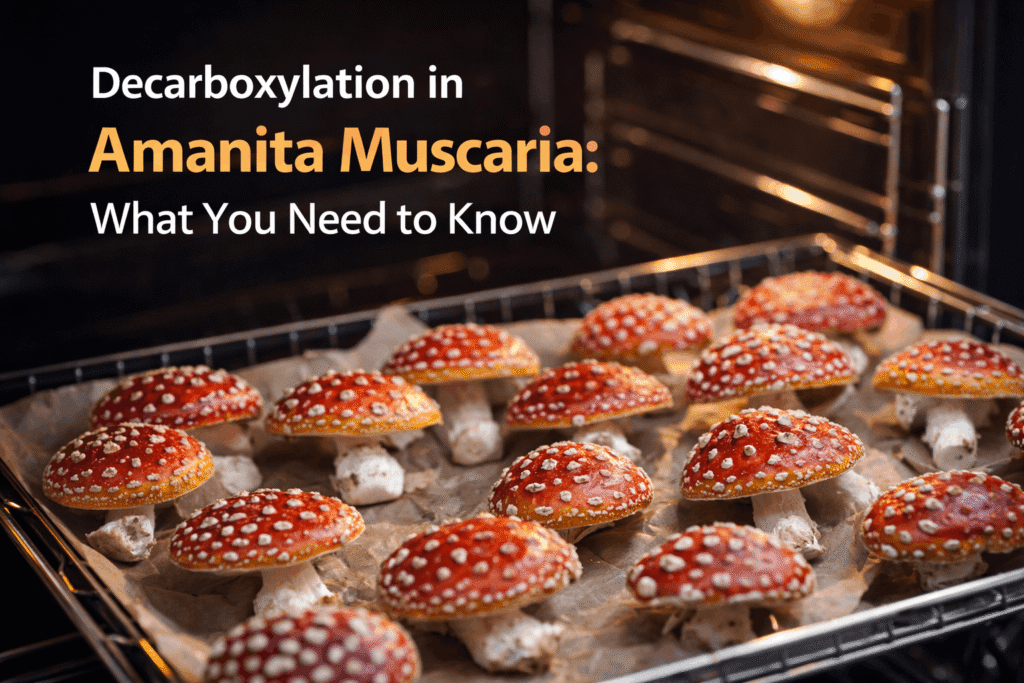
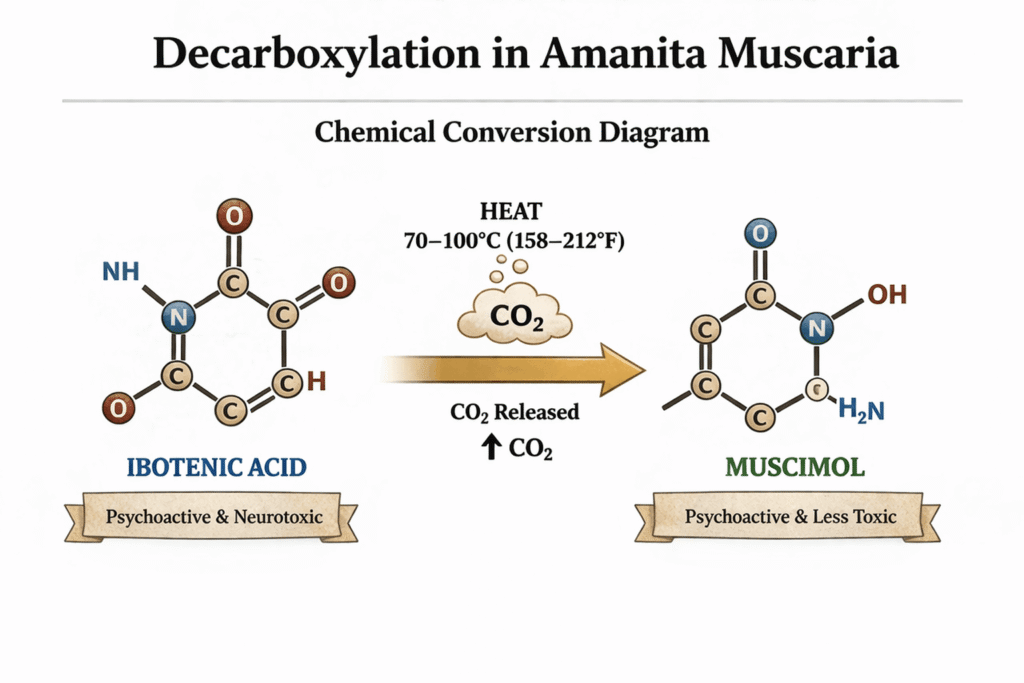
Decarboxylation is the process that makes Amanita muscaria safe and effective. It converts ibotenic acid, the compound responsible for nausea and unpleasant side effects, into muscimol, the calming compound people actually want. This happens through heat and acidic conditions, and the quality of this conversion is the single biggest factor separating a good Amanita muscaria product from a bad one.
If you’ve spent any time researching Amanita muscaria, you’ve probably come across the word “decarboxylation.” It sounds complicated, but the concept is straightforward: raw Amanita muscaria contains a compound that makes you feel terrible, and proper processing converts it into a compound that makes you feel good. That conversion is decarboxylation.
Understanding this process matters because it’s the clearest way to evaluate product quality. A company that gets decarboxylation right delivers a smooth, predictable experience. A company that cuts corners leaves harsh, unwanted compounds in the final product. At Mushroom Magical, proper decarboxylation is central to how we make our Amanita muscaria gummies and chocolate bars. It’s why we invest in controlled processing and third-party lab testing for every batch.
Why Does Ibotenic Acid Need to Convert to Muscimol?
Ibotenic acid needs to convert to muscimol because the two compounds do opposite things in the brain. Ibotenic acid overstimulates neurons, causing nausea, muscle twitching, confusion, and unpredictable reactions. Muscimol does the reverse, it calms neural activity, producing the relaxation and introspective effects people seek from Amanita muscaria.
The chemical difference between them is actually small. Decarboxylation removes a single molecular group from ibotenic acid, but that small change completely flips the compound’s behavior. Ibotenic acid agitates the nervous system. Muscimol soothes it. Same mushroom, radically different experience depending on how it’s processed.
The numbers make this concrete. Fresh Amanita muscaria caps contain roughly nine parts ibotenic acid for every one part muscimol. That means the raw mushroom is overwhelmingly composed of the compound you don’t want. Proper decarboxylation reverses that ratio, converting most of the ibotenic acid into muscimol and leaving you with the calming, beneficial compound.
This is why raw Amanita muscaria has such a harsh reputation. People who eat it unprepared are mainly experiencing ibotenic acid, not muscimol. Traditional Siberian users figured this out centuries ago. They developed drying and heating methods that effectively achieved decarboxylation long before the underlying chemistry was understood.
What Temperature and Conditions Work Best?
Effective decarboxylation needs heat, and it works significantly better when heat is combined with acidic conditions. Temperatures in the range of 175–200°F are the sweet spot, high enough to drive the conversion but not so high that the resulting muscimol starts breaking down. Above 200°F, you start destroying the compound you’re trying to create.
Here’s what most people don’t realize: simply drying Amanita muscaria in a dehydrator or oven only converts about 30% of the ibotenic acid. That’s according to a U.S. patent on muscimol production, and it matches what independent researchers have found. Drying alone leaves the majority of ibotenic acid intact, which is why some dried mushroom products still cause unpleasant side effects.
The real gains come from combining heat with low-pH (acidic) conditions. Research shows that adding citric acid or lemon juice to bring the pH down while heating can increase conversion yield roughly fivefold compared to heat alone. This is why the traditional method of simmering dried mushrooms in acidified water is so much more effective than just putting them in a dehydrator.
Commercial manufacturers take this further with precision equipment, controlled temperatures within a few degrees of target, optimized pH levels, and sometimes enzymatic processing. This is why professionally produced products deliver more consistent results than home preparation, where variables are much harder to control.
How Does Drying Method Affect the Result?
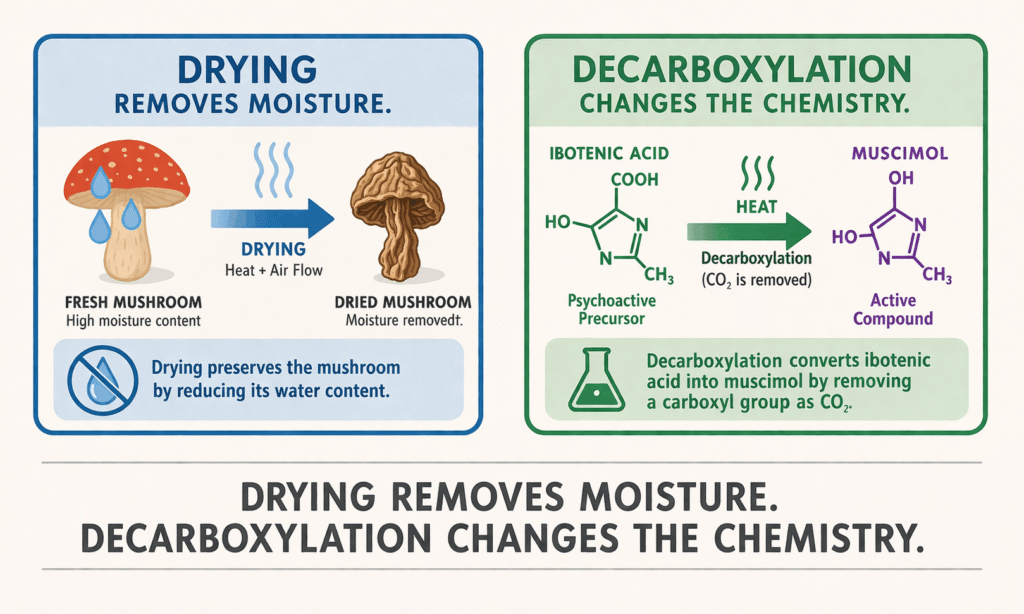
Not all drying methods achieve the same level of conversion, and this is where a lot of consumer confusion comes from. Many sellers market their dried mushrooms as “decarboxylated,” but drying and decarboxylation aren’t the same thing. Drying removes moisture. Decarboxylation changes the chemistry. Drying contributes to decarboxylation, but it doesn’t finish the job on its own.
Air drying at room temperature is the slowest approach. It removes moisture over days or weeks and achieves minimal conversion. It’s useful for preservation but not for producing a high-muscimol product.
Dehydrators at 160–170°F do better by applying consistent low heat, but they still only partially convert the ibotenic acid. They’re a reasonable first step, not a complete solution.
Oven drying at higher temperatures (175–200°F) pushes conversion further, but household ovens are inconsistent; hot spots, temperature swings, and uneven exposure mean results vary from batch to batch.
Professional extraction combines optimized temperature, controlled acidity, and precise timing to maximize conversion while preserving the full spectrum of beneficial compounds. This multi-variable approach is what separates standardized commercial products from homemade preparations, and it’s why lab-tested products from reputable brands deliver a more reliable experience.
How Can You Tell If Decarboxylation Was Done Properly?
Laboratory testing using HPLC (high-performance liquid chromatography) is the only way to know exactly how much muscimol and ibotenic acid a product contains. But if you’re evaluating dried mushroom material rather than a manufactured product, there are physical signs that indicate whether significant processing has occurred.
Color is the most obvious cue. Raw Amanita muscaria has bright red caps with white spots. Properly heat-processed material darkens to a deep orange-brown or rusty shade. If dried mushroom material still looks vibrantly red, it likely hasn’t been thoroughly processed.
Texture tells a story too. Well-decarboxylated material is completely brittle; it snaps cleanly and crumbles into powder between your fingers. Material that still bends or feels slightly flexible probably retains more ibotenic acid and moisture.
Weight loss offers a rough check. Properly processed mushrooms lose 85–90% of their original weight as moisture leaves. If the material hasn’t lost most of its weight, processing was likely insufficient.
These are useful guidelines for raw material, but they can’t tell you precise compound ratios. For manufactured products like gummies or extracts, the only real assurance is third-party lab testing that verifies muscimol content and confirms ibotenic acid has been minimized.
What Happens When Decarboxylation Is Incomplete?
This is where product quality really matters. Incomplete decarboxylation means residual ibotenic acid in the final product, which translates directly to a worse experience, more nausea, physical discomfort, muscle twitching, and a foggy, unpleasant mental state.
The core problem is that ibotenic acid and muscimol work against each other. One revs up neural activity while the other calms it down. When both are present in significant amounts, the result is a disorienting push-pull that users describe as “dirty” or chaotic, nothing like the clear, relaxing effects of properly converted muscimol.
There’s also a hidden dosing risk. Partially converted products feel weaker because ibotenic acid is less potent per milligram than muscimol. So people take more to feel something, but in doing so, they’re also consuming more ibotenic acid, increasing the chance of adverse reactions. It’s a trap that proper decarboxylation eliminates entirely.
This isn’t a theoretical concern. The FDA’s December 2024 warning, which declared Amanita muscaria compounds not authorized for food use, was partly driven by adverse events linked to poorly made products. Many of those products contained undisclosed substances, but inadequate processing of the mushroom itself was also a factor.
Choosing brands that prioritize proper decarboxylation and transparent testing directly addresses these safety concerns.
How Do Quality Manufacturers Get It Right?
Serious manufacturers treat decarboxylation as a controlled, measurable process, not something that happens incidentally during drying. The difference shows up in every aspect of production.
It starts with the raw material. Reputable producers test incoming mushrooms for species verification, contamination, and baseline compound levels. Since wild Amanita muscaria varies enormously in potency depending on where and when it was harvested, this initial testing determines how each batch needs to be processed.
Processing itself uses equipment that holds precise temperatures throughout the run, combined with optimized acidity and timing. Many manufacturers follow multi-stage protocols: removing moisture first, then applying targeted heat and pH conditions to maximize ibotenic acid conversion without degrading the resulting muscimol.
Verification is where good brands separate from the rest. After processing, HPLC testing quantifies the exact muscimol and ibotenic acid content in each batch. Quality manufacturers test multiple samples to catch any within-batch variation. Third-party labs provide independent confirmation, checking not just compound profiles but also contaminants like heavy metals and pesticides.
At Mushroom Magical, we publish our lab reports so you can see exactly what’s in every batch. We combine Amanita muscaria extract with Lion’s Mane, Chaga, Reishi, and Cordyceps, functional mushrooms that complement the calming properties of properly converted muscimol.
Does the Process Affect Other Beneficial Compounds?
When done correctly, decarboxylation targets ibotenic acid specifically without damaging other beneficial compounds in the mushroom. The key is temperature control; staying below 200°F preserves muscazone (a mildly sedative compound that complements muscimol), polysaccharides, and various trace alkaloids.
This matters because whole-mushroom preparations appear to work differently than isolated compounds. The interaction between muscimol, muscazone, and other naturally occurring substances may contribute to the distinctive character of Amanita muscaria, similar to how full-spectrum botanical products often behave differently than single-compound extracts.
The one visible change is color. The pigments responsible for the mushroom’s iconic red cap darken during heat processing, shifting toward orange-brown. This is cosmetic, not functional. The compounds that matter for your experience remain intact when processing is done within the right temperature range.
Some manufacturers deliberately use lower temperatures over longer periods specifically to preserve this full compound profile. The tradeoff is longer processing time, but the goal is the same: maximum ibotenic acid conversion with minimum collateral damage to everything else in the mushroom.
Frequently Asked Questions
Can you decarboxylate Amanita muscaria by boiling it?
Boiling does start the conversion, but it also pulls compounds out of the mushroom material and into the water. If you toss the mushrooms and keep the water, you’ll have some muscimol in solution, but you’ll also have lost material. Simmering at a lower temperature in acidified water works better because the low pH dramatically accelerates conversion. That said, commercial extraction gives the most consistent and complete results.
How long does muscimol stay stable after processing?
Properly dried Amanita muscaria products maintain stable muscimol content for 12–24 months when stored in airtight containers away from light, heat, and moisture. Muscimol is a relatively stable compound under normal conditions. The main threats to shelf life are humidity (which can promote mold) and prolonged heat or sunlight exposure.
Is decarboxylation-derived muscimol the same as naturally occurring muscimol?
Identical. The process removes one molecular group from ibotenic acid, and the result is the exact same muscimol compound that exists naturally in the mushroom in small amounts. No structural or functional difference whatsoever.
Can you over-process and destroy muscimol?
Yes. Muscimol starts breaking down above 200°F, with significant degradation above 250°F. Extended processing at moderate temperatures (6+ hours) can also reduce potency. This is why professional manufacturers carefully balance conversion completeness against compound preservation, going far enough to convert the ibotenic acid but stopping before they degrade the muscimol.
Does chopping or grinding before processing help?
Smaller pieces allow heat to penetrate more evenly, which improves conversion consistency. Thin slices or small chunks work well. Very fine powder can actually clump during heating and create uneven exposure, so finer isn’t always better.
How do traditional methods compare to modern processing?
Traditional Siberian preparation, drying near fires and simmering in liquid, applies the same core principles that modern science has validated: heat converts ibotenic acid to muscimol. These methods work, but with far less consistency than controlled commercial processing. Modern techniques add precise temperature management, optimized pH, and lab verification to achieve reliable, standardized results across every batch.
Disclaimer: This article is for educational and informational purposes only. Consult a healthcare provider before using any mushroom-based supplements. Mushroom Magical provides third-party lab reports for all products.