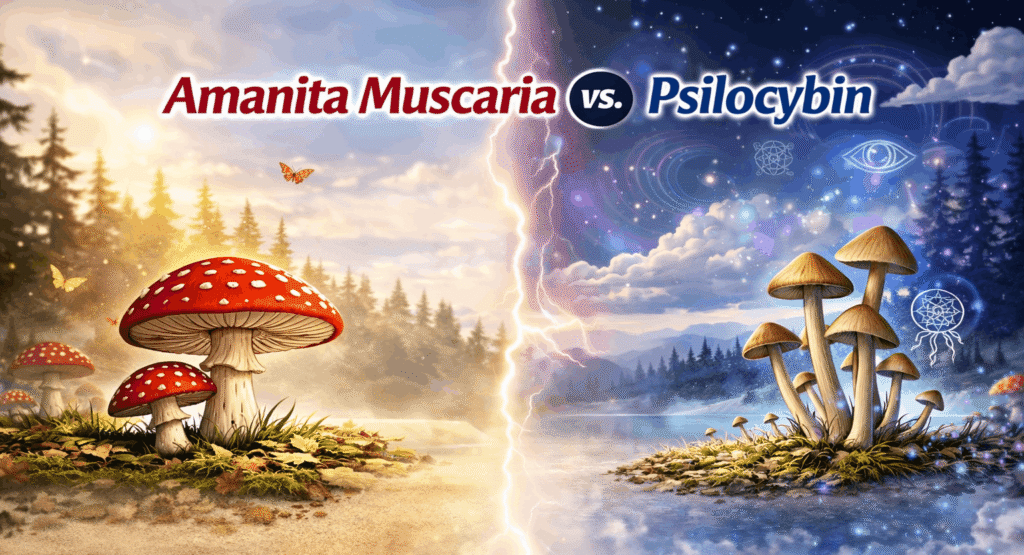
Amanita Muscaria and psilocybin are fundamentally different compounds that work through distinct mechanisms in the body. Amanita Muscaria contains muscimol and ibotenic acid, which interact with GABA receptors to produce relaxing, dream-like effects. Psilocybin converts to psilocin and binds to serotonin receptors, creating intense psychedelic experiences. Their legal status, safety profiles, and effects vary dramatically. Amanita Muscaria is federally legal and milder, while psilocybin remains a Schedule I controlled substance with far more intense effects.
The world of psychoactive mushrooms extends far beyond a single category. Two species have captured human fascination for centuries: the striking red-capped Amanita Muscaria and psilocybin-containing “magic mushrooms.” While both are psychoactive, they represent entirely different chemical families with unique effects, histories, and safety profiles.
Understanding these differences matters whether you’re interested in ethnobotany, natural wellness, or simply expanding your knowledge. At Mushroom Magical, we specialize in legal, wellness-focused Amanita Muscaria products that harness this fascinating mushroom in controlled, accessible forms.
What Chemical Compounds Make Amanita Muscaria and Psilocybin Different?
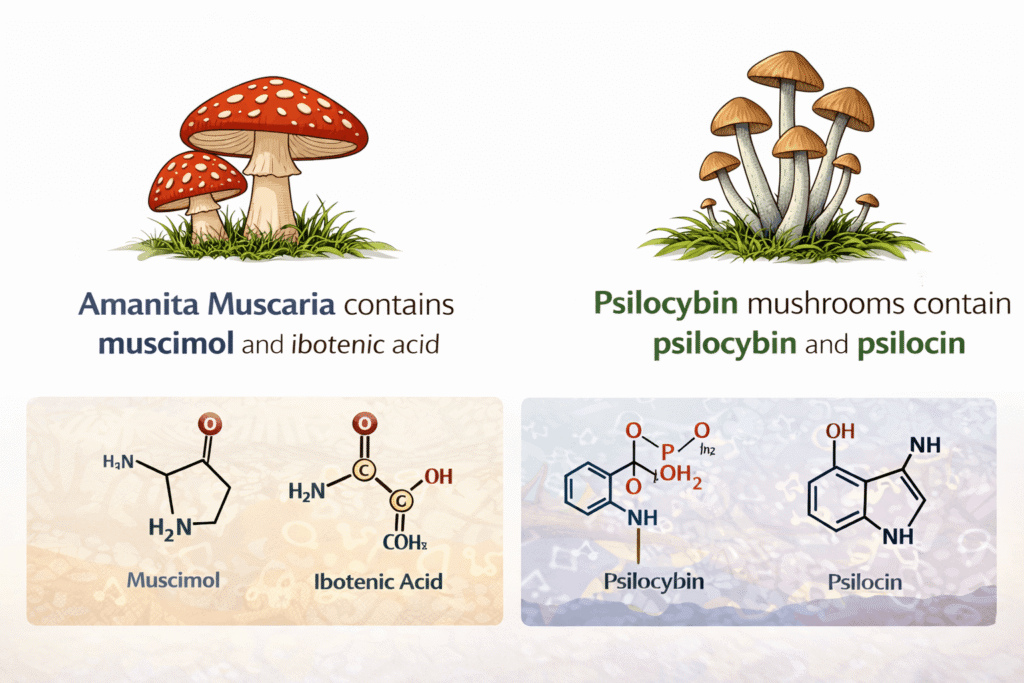
Amanita Muscaria contains muscimol and ibotenic acid, which work through different mechanisms. Muscimol acts as a GABA receptor agonist, mimicking the brain’s primary calming neurotransmitter. Ibotenic acid acts as an NMDA glutamate receptor agonist, contributing to the overall psychoactive effects.
Psilocybin mushrooms contain psilocybin and psilocin, tryptamine alkaloids that bind to serotonin receptors. These fundamentally different chemical structures mean they interact with entirely separate neurotransmitter systems, producing distinct effects.
Muscimol creates calming, sedative effects by mimicking GABA (gamma-aminobutyric acid). Ibotenic acid, the precursor compound, converts to muscimol through decarboxylation when the mushroom is dried or heated.
This conversion is crucial because ibotenic acid acts on NMDA receptors and can cause unpleasant side effects like nausea and confusion, while muscimol produces the desired relaxing properties. Modern Amanita Muscaria gummies use standardized extraction to ensure this conversion is complete.
Psilocybin belongs to the tryptamine family and shares structural similarities with serotonin. Once ingested, enzymes rapidly convert psilocybin into psilocin, which crosses the blood-brain barrier and binds to 5-HT2A serotonin receptors. This disrupts normal neural patterns and increases communication between brain regions that don’t typically interact, creating altered perception, enhanced emotions, and modified thought patterns.
The metabolic differences are notable as well. Muscimol is relatively stable and partially excreted unchanged. Psilocin is rapidly metabolized by the liver, with most converted to inactive compounds within hours. These pathways influence how long effects last and how the body processes each substance.
How Do the Effects of Amanita Muscaria Compare to Psilocybin?
Amanita Muscaria typically produces relaxing, sedative effects with dream-like qualities, altered time perception, and mild euphoria, without the intense visual hallucinations characteristic of psilocybin. Psilocybin creates profound psychedelic experiences with vivid hallucinations, ego dissolution, and dramatic shifts in consciousness. The two experiences exist on entirely different spectrums.
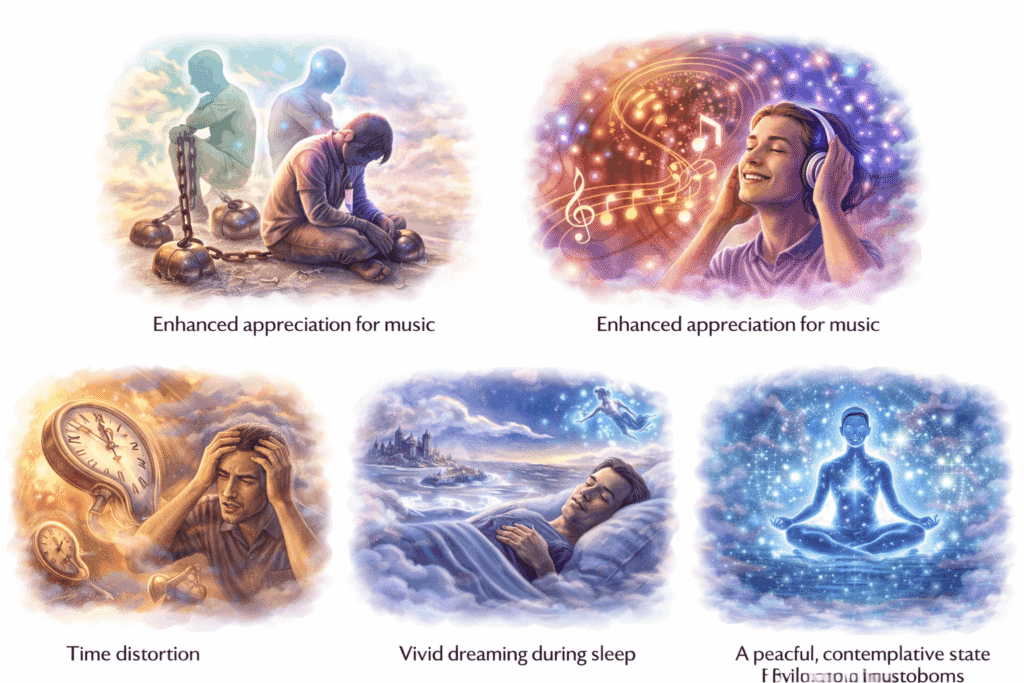
Amanita Muscaria effects tend to feel more grounding than transcendent. Common experiences include:
- A sense of physical heaviness or lightness
- Enhanced appreciation for music
- Time distortion where minutes feel like hours
- Vivid dreaming during sleep
- A peaceful, contemplative state similar to a lucid dream
Colors may appear slightly more vibrant, but visual changes rarely approach the kaleidoscopic patterns of classical psychedelics. Many users describe maintaining awareness and control throughout.
Psilocybin effects operate at a different level of intensity. At moderate to high doses, users experience geometric visual patterns, synesthesia, amplified emotions, and temporary ego dissolution. These experiences can be spiritually significant but also potentially overwhelming.
Duration also differs. Amanita Muscaria effects begin 30–90 minutes after consumption, peak around 2–3 hours, and gradually fade over 4–8 hours with a gentle onset. Psilocybin acts faster (20–40 minutes), peaks at 2–3 hours, and lasts 4–6 hours, often with a rapid and intense come-up.
What Is the Legal Status of Each Mushroom Type?
Amanita Muscaria is legal in most jurisdictions, including nearly every U.S. state except Louisiana, though consumers should always verify their own state’s current regulations. Psilocybin remains a Schedule I controlled substance under federal law. This legal distinction dramatically affects accessibility, research opportunities, and how each substance can be marketed and sold.
Because muscimol and ibotenic acid aren’t scheduled under the Controlled Substances Act, Amanita Muscaria products can be legally sold and shipped across most state lines. This has enabled companies like Mushroom Magical to develop safe, lab-tested products that consumers can access without legal concerns.
Psilocybin’s illegal status dates to the Controlled Substances Act of 1970. Possession, cultivation, or distribution can result in felony charges. However, the tide is shifting. Oregon legalized supervised psilocybin therapy in 2020, Colorado followed in 2022, and several cities have decriminalized possession.
These changes reflect growing recognition of psilocybin’s therapeutic potential, but commercial access remains extremely limited compared to legal Amanita Muscaria products.
What Are the Historical and Cultural Uses of Each Mushroom?
Amanita Muscaria has been used for thousands of years in Siberian shamanic traditions and appears in cultural imagery worldwide. Psilocybin mushrooms hold sacred significance in Mesoamerican cultures, particularly among indigenous peoples in Mexico. Both have deep cultural roots but in distinctly different geographic regions and spiritual contexts.
Siberian shamans among the Koryak, Kamchadal, and Chukchi peoples consumed Amanita Muscaria during winter solstice ceremonies. The mushroom also became the iconic “toadstool” of European fairy tales, appearing in mu and German folklore. Some researchers suggest connections to Santa Claus mythology, though this remains debated.
Psilocybin mushrooms carry equally profound significance. The Aztecs called them teonanácatl (“flesh of the gods”) and used them in religious ceremonies. Modern Western interest exploded in the 1950s when R. Gordon Wasson published his account of a Mazatec ceremony in Life magazine, sparking the research that eventually led to today’s psychedelic renaissance.
What Safety Considerations Apply to Each Mushroom?
Amanita Muscaria requires proper preparation to reduce ibotenic acid content, and dosing can be unpredictable with raw mushrooms. Psilocybin has a favorable physical safety profile with extremely low toxicity but carries psychological risks including anxiety and triggering latent mental health conditions. Neither is physically addictive, but both demand respect.
Amanita Muscaria safety hinges on preparation. Raw mushrooms can cause nausea, confusion, and muscle twitching from ibotenic acid. Traditional methods like drying, heating, or parboiling convert ibotenic acid to muscimol. Commercial products from Mushroom Magical’s store use standardized extraction to ensure consistent potency and minimize unwanted compounds, offering a far safer option than wildcrafted mushrooms.
Potency varies dramatically between individual wild mushrooms depending on growing conditions, location, and harvest time. Standardized extracts solve this problem by quantifying active compound content for more precise dosing.
Psilocybin’s physical safety is generally favorable compared to many other substances. The estimated lethal dose is approximately 1000 times higher than the typical recreational dose. However, while fatal psilocybin poisoning is rare, recent case reports (2024-2025) have documented serious adverse events, including acute kidney injury and liver failure, in some users, particularly when combined with other substances or in individuals with underlying health conditions.
Psilocybin doesn’t typically cause organ damage in healthy individuals, and it’s not physically addictive. However, people with a personal or family history of psychotic disorders should avoid it, as it may trigger latent conditions. Challenging experiences can be psychologically distressing, and mixing psilocybin with SSRIs or MAOIs can be dangerous.
Can Either Mushroom Be Used for Wellness or Therapy?
Psilocybin has demonstrated remarkable therapeutic potential in clinical trials for depression, PTSD, addiction, and end-of-life anxiety. Amanita Muscaria has traditional uses for pain relief, sleep support, and anxiety reduction, though scientific research remains more limited. Both are being explored for wellness, but psilocybin has substantially more clinical evidence.
Clinical trials at Johns Hopkins, Imperial College London, and Yale have shown psilocybin-assisted therapy can produce rapid improvements in treatment-resistant depression, often after just one or two sessions. The FDA has granted “breakthrough therapy” designation for psilocybin-assisted treatment of treatment-resistant depression.
Amanita Muscaria’s GABAergic activity provides a plausible mechanism for anti-anxiety and sleep-promoting effects. Some users report that microdosing provides subtle cognitive benefits, improved sleep quality, and reduced anxiety. By combining Amanita Muscaria extracts with functional mushrooms like Lion’s Mane, Reishi, Chaga, and Cordyceps, Mushroom Magical’s wellness products aim to provide balanced benefits in a legal, accessible format without the intensity of a full psychedelic experience.
How Do Dosage and Potency Differ Between These Mushrooms?
Amanita Muscaria dosing typically ranges from 1–5 grams of dried mushroom for mild effects, but potency varies wildly between specimens. Psilocybin mushrooms contain 0.2–2% psilocybin by dry weight, with common doses ranging from 1–2 grams for beginners to 3.5+ grams for experienced users. Standardized extracts provide more consistent dosing for both, reducing the guesswork of whole mushrooms.
The challenge with wild Amanita Muscaria is enormous variability. A cap from one location might contain three times the muscimol of another. Modern extraction technology has solved this by quantifying active compounds in milligrams, enabling consistent experiences and reliable microdosing protocols (typically 1–3 mg of muscimol).
Psilocybin mushrooms vary less but still fluctuate. The most common species, Psilocybe cubensis, typically contains 0.5–1.2% psilocybin by dry weight. Standard dosing ranges from 0.1–0.3 grams for microdosing to the “heroic dose” of 5+ grams. Individual sensitivity, body weight, and tolerance all influence effects.
Frequently Asked Questions
Can you mix Amanita Muscaria and psilocybin together?
Combining them is not recommended and has not been studied scientifically. They work through different neurotransmitter systems, and their interaction is unpredictable. Each substance should be experienced separately with proper preparation.
Does Amanita Muscaria show up on drug tests?
No. Muscimol and ibotenic acid are not included in standard drug screening panels. Since Amanita Muscaria is legal in most jurisdictions, testing agencies generally have no reason to screen for these compounds.
How does tolerance develop with each mushroom type?
Psilocybin creates rapid tolerance that takes 3–14 days to reset fully. Amanita Muscaria tolerance appears slower and less pronounced, though research is limited. Neither creates physical dependence.
Are there deadly mushrooms that look like Amanita Muscaria or psilocybin mushrooms?
Yes. Amanita Muscaria can be confused with deadly species like the destroying angel (Amanita virosa) or death cap (Amanita phalloides). Psilocybin mushrooms can be confused with toxic Galerina marginata. Never consume wild mushrooms without expert identification. Using properly tested commercial products eliminates this risk entirely.
Can Amanita Muscaria be microdosed like psilocybin?
Yes. Anecdotal reports suggest benefits including improved sleep, reduced anxiety, and enhanced creativity. Unlike psilocybin microdosing, Amanita Muscaria microdosing is legal. Standardized extracts with known muscimol content are essential for consistent results.
What’s the difference in the comedown between these mushrooms?
Psilocybin produces a gradual decrease over 2–3 hours after peak, often with a positive “afterglow” the next day. Amanita Muscaria’s comedown is gentler, with users typically feeling relaxed and sleepy as effects fade. Neither produces harsh crashes or withdrawal symptoms.
Disclaimer
This article is for informational and educational purposes only. Psilocybin mushrooms are controlled substances in most jurisdictions. Amanita Muscaria products are not intended to diagnose, treat, cure, or prevent any disease and have not been evaluated by the FDA. Always consult a healthcare provider before using any mushroom-based products. Mushroom Magical promotes responsible, legal use of our products.